What happened that helped convince Congress to pass the Civil Rights Act?
The Civil Rights Act of 1964
The civil rights movement deeply afflicted American gild. Among its nearly important achievements were two major civil rights laws passed past Congress. These laws ensured constitutional rights for African Americans and other minorities. Although these rights were first guaranteed in the U.Southward. Constitution immediately after the Civil War, they had never been fully enforced. It was just after years of highly publicized civil rights demonstrations, marches, and violence that American political leaders acted to enforce these rights.
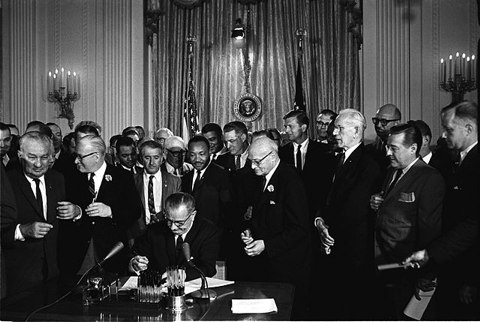 |
| President Lyndon Johnson signs the historic Civil Rights Act of 1964. Behind him stands the Reverend Martin Luther Male monarch Jr. (Wikimedia Commons) |
President John F. Kennedy proposed the initial civil rights deed. Kennedy faced great personal and political conflicts over this legislation. On the one paw, he was sympathetic to African-American citizens whose dramatic protests highlighted the glaring gap between American ideals and American realities. Kennedy understood that black people deserved the total equality they were demanding. He also knew that racial discrimination in the United States, particularly highly public displays of violence and terror against racial minorities, embarrassed America internationally. Moreover, his civil rights legislation generated considerable support among Northern liberals and moderates too every bit millions of African-American voters in states where they could vote without difficulty or intimidation.
On the other hand, Kennedy worried about losing the support of white Southern Democrats, even so the primary political force in that region. He was particularly concerned nigh his re-election prospects in 1964. Facing strong Southern opposition, a reluctant president finally proposed potent civil rights legislation to Congress, albeit privately to civil rights leaders that street protests had forced his hand.
Johnson and the Ceremonious Rights Bill
Kennedy'due south assassination on Nov 22, 1963, changed the political dynamics of the impending ceremonious rights legislation. Vice President Lyndon B. Johnson succeeded Kennedy and almost immediately intensified the campaign for a major civil rights beak. Although a Southern politician, he had adult compassion for the courageous struggles of African Americans during the civil rights motion. His personal commitment to ensuring total equality for minority citizens, in fact, surpassed Kennedy'southward.
Johnson stood in a better position than his predecessor to push the civil rights legislation through Congress. An extremely achieved politician, Johnson thoroughly understood Congress and its complex operations. For many years, he had served equally the Senate majority leader. With the responsibleness to guide legislation through Congress, he had worked with colleagues of both parties and dissimilar outlooks. During his service, he mastered the fine art of compromise, gaining many victories for his party's legislative calendar. He also adult close relationships with senators and representatives of both political parties. He regularly used that personal noesis, combined with charm, flattery, and threats, to achieve his legislative goals. This skill proved particularly useful in getting Congress to pass a major civil rights bill.
President Johnson used another key strategy to pass the civil rights pecker. He took advantage of the national sympathy and mourning surrounding Kennedy's tragic decease. In public speeches and individual talks, he urged passage of the civil rights act as a lasting legacy to the martyred president. Building widespread public back up, he urged religious leaders throughout the nation (specially in the South) to apply their influence on behalf of the civil rights human activity.
The actual battle in Congress took all of Johnson'southward political skills. Faced with strong opposition from many Republicans and nearly Southern Democrats, he resorted to his forceful personal powers. He told Georgia Senator Richard Russell, a major opponent of civil rights legislation, that "if you get in the way, I'm going to run you downwardly." In the Senate, the president faced a filibuster, a delaying fence that could have killed the entire neb. The delay lasted 83 days, the longest in Senate history. But Johnson managed to get the votes to end it. He worked the telephones himself and lobbied personally, "twisting arms" of legislators nonetheless unsure of how to vote. Enlisting White House aides, civil rights and labor leaders, and key congressional civil rights advocates, he pulled out all the stops to gain a legislative victory.
Johnson's persistence and political talents succeeded. On July 2, 1964, he formally signed the Civil Rights Act of 1964 into police force, using 72 ceremonial pens. Many dignitaries, including Martin Luther King, Rosa Parks, and several other national ceremonious rights figures, attended the ceremony. This law banned racial discrimination in several areas, including hotels, restaurants, education, and other public accommodations. This landmark act too guaranteed equal job opportunities, fulfilling one major objective of the historic 1963 March on Washington. Many larger Southern businesses had already desegregated in response to sit-ins and other ceremonious rights protests. Merely the Civil Rights Human activity of 1964 added important legal protections to these political and social developments.
Almost immediately, the new civil rights law came nether legal claiming. The owner of an Atlanta cabin argued that Congress did not have the authority under the U.S. Constitution to ban segregation in public accommodations. This 216-room establishment, which served an interstate clientele, had long refused to rent rooms to African Americans. When Center of Atlanta Motel, Inc. v. United States reached the Supreme Courtroom, the court rejected the owner's argument. It ruled that the commerce clause of the Constitution authorized Congress to enact this blazon of legislation. Ceremonious rights advocates had achieved their most significant legal victory since the 1954 Chocolate-brown five. Board of Education decision banning school segregation.
For Discussion and Writing
- What did the Civil Rights Act of 1964 practice? Do you call up it was effective?
- Why was President Johnson able to pass the Civil Rights Deed of 1964? Practise you think President Kennedy would have been able to become it passed? Explain.
For Further Reading
Loevy, Robert D. The Civil Rights Act of 1964: The Passage of the Law that Ended Racial Segregation. New York: Land University of the New York Printing. 1997
Mayer, Robert. The Civil Rights Act of 1964. Michigan: Greenhaven Publishing. 2004.
Return to Black History Calendar month Domicile Page
knowlesbetimesely.blogspot.com
Source: https://www.crf-usa.org/black-history-month/the-civil-rights-act-of-1964

Post a Comment for "What happened that helped convince Congress to pass the Civil Rights Act?"